Well, AI is probably one of the most deliberated topics of our times. Readers may already have formed an opinion about it depending on which side of the debate they belong to. I would request you to hold on to that opinion till you finish reading this because, quite honestly, even I am not sure where this thought will finally land.
That is the beauty of our minds, isn’t it? We often begin with one idea and end up discovering another. For the purpose of this article, I am limiting my thoughts to the security landscape.
Let me begin by saying that I am not against AI. In fact, I believe that any organization that refuses to embrace technology today is doing itself a disservice. Automation, analytics, surveillance systems, intelligent monitoring, predictive tools, AI-driven assessments – all of these are becoming necessities rather than luxuries.
And rightly so. If technology can make organizations safer, faster, more efficient and more responsive, why should we not adopt it? The question that keeps bothering me, however, is slightly different. As organizations are investing heavily in upgrading their technological capabilities, are they investing with the same seriousness in upgrading the capabilities of their people?
Because during my experience of conducting Security Risk Assessments, reviewing Business Continuity Plans, evaluating Crisis Management Frameworks and interacting with security teams across organizations, I have noticed a pattern. Everybody wants better technology. Very few people are talking about better human beings.
Let me explain. A perimeter that may have earlier required ten guards can today be monitored through a combination of CCTV systems, intrusion detection systems, motion sensors, analytics, alarms and remote monitoring capabilities. The requirement for manpower may reduce significantly.
And I completely agree with that. That is precisely the purpose of automation. Technology should eliminate repetitive work. It should improve efficiency. It should allow us to do more with less. But what I do not agree with is the silent assumption that because manpower has reduced, investment in manpower can also reduce. In fact, my belief is exactly the opposite. If technology is becoming more sophisticated, the people operating it should become more sophisticated too. The fewer people you have, the better they need to be. The guard, the supervisor, the manager, the analyst sitting behind the screen – they all need to be operating at a much higher level of professional competence than before.
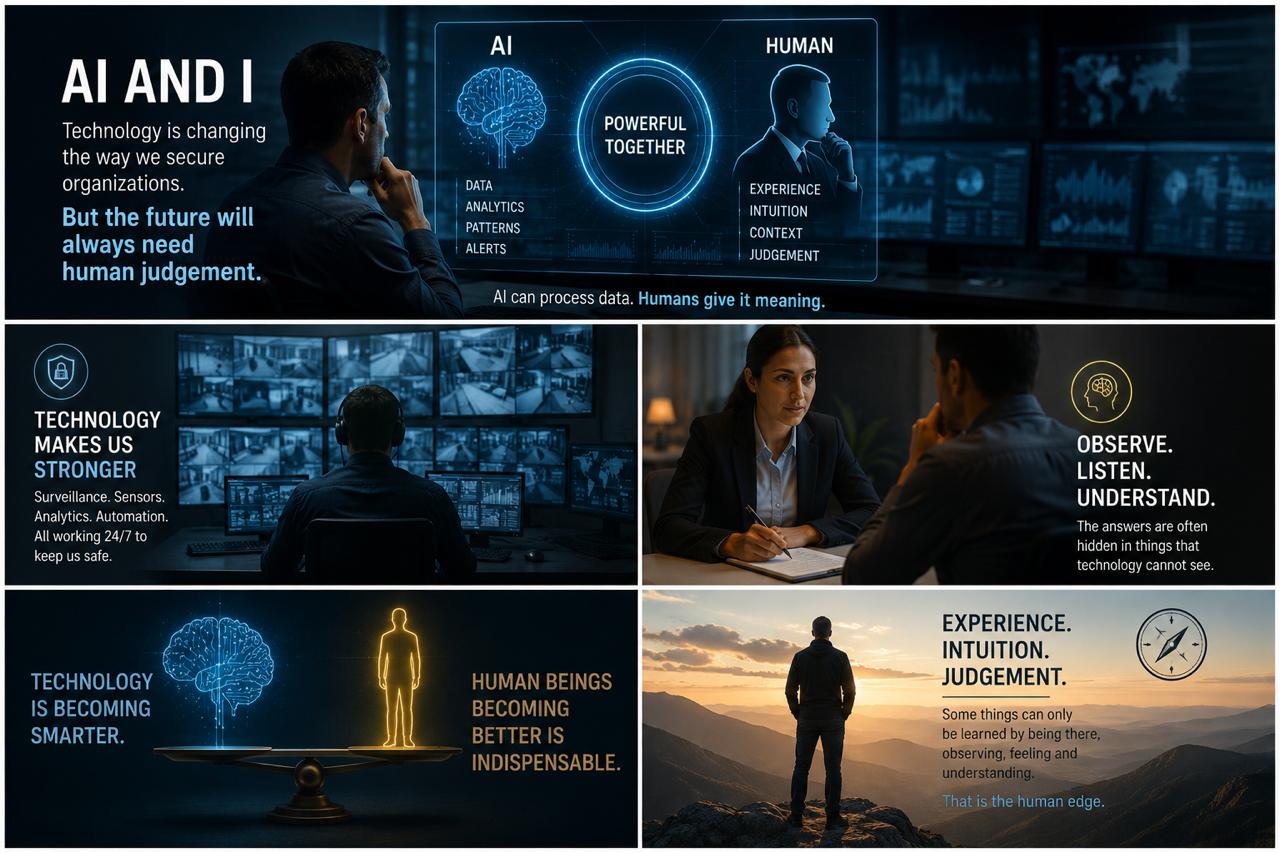
Because technology can generate data. Technology can generate alerts. Technology can generate reports. Technology can even identify patterns. But technology still requires human judgement. It still requires someone to ask the right questions. It still requires someone to differentiate between noise and a genuine threat. It still requires someone to make decisions when the situation does not fit neatly into predefined algorithms. And perhaps my view is influenced by the kind of work I do.
And perhaps this belief comes from the way assessments are actually conducted in the field. I am not merely following a checklist. I am bringing with me years of experience, professional training, lessons learnt from previous assignments, observations gathered over time and the ability to connect seemingly unrelated pieces of information. Part of the assessment comes from documents, policies, procedures and records. Part of it comes from what I see. Part of it comes from what I hear.
And a surprisingly large part of it comes from what does not seem right. Sometimes it is a hesitation before answering a question. Sometimes it is a body language mismatch. Sometimes it is a process that appears perfect on paper but feels strangely disconnected from reality. Sometimes it is something as simple as noticing that a security control looks unusually new, unusually highlighted, or unusually prepared for the day of the assessment.
On more than one occasion, I have come across situations where records appeared compliant but a closer look suggested otherwise. The documents existed. The signatures existed. The evidence existed. Yet something did not add up. Not because I had access to better technology. But because human beings have an extraordinary ability to observe context.
We notice inconsistencies. We sense discomfort. We identify patterns that have never been formally defined. We ask questions that no system was instructed to ask. And very often, the answer lies not in the information that is available but in the information that is missing. This is where I believe human judgement continues to occupy a very special place. AI can process vast amounts of data. It can identify correlations. It can highlight anomalies.
But the ability to stand in an environment, absorb hundreds of visible and invisible cues, apply experience, intuition, professional judgement and context and then arrive at a conclusion remains deeply human. At least for now. Perhaps this is also where my relationship with AI becomes a little more personal. Over the years, I have realised that one of my greatest strengths as a security professional, investigator and consultant has very little to do with security itself. It has to do with people.
A large part of my journey, both professionally and personally, has involved understanding human beings. Observing them. Listening to them. Working with them. Sometimes helping them navigate challenges. Sometimes simply sitting with them and trying to understand what drives them, what scares them, what motivates them and what they are unable to say. I have consciously invested a great deal of my time and energy into understanding people. Not because I knew it would help me professionally.
But because I have always been fascinated by human behaviour. In hindsight, I think that investment has helped me in every role I have ever performed. Whether it was leading teams, running a security agency, conducting investigations, carrying out risk assessments, interviewing employees, reviewing incidents or advising organizations, I found myself relying repeatedly on my ability to understand people. Very often, the answer was not hidden in a document.
It was hidden in a reaction. It was not in a policy. It was in a hesitation. It was not in a report. It was in what somebody chose not to say. The more I worked with people, the better professional I became. And perhaps that is why I continue to believe that while technology will continue to evolve at an extraordinary pace, the human ability to observe, empathize, interpret and understand context will remain one of the most valuable capabilities we possess.
There is another thought that often crosses my mind. Organizations are usually willing to invest significant amounts of money in technology upgrades. A new surveillance platform, a sophisticated command centre, advanced analytics, AI-enabled monitoring, intelligent access control systems – all of these are considered strategic investments. And perhaps they are. What I find interesting, however, is the contrast.
The same organization that is willing to invest heavily in technology often becomes extremely cautious when it comes to investing in the people expected to operate that technology. The discussion suddenly shifts to budgets, optimization, headcounts, resource rationalization and cost efficiency. Somewhere along the way, we seem to have accepted the idea that technology is an asset while people are a cost. I am not sure that is a very wise assumption.
Because if organizations truly believe that technology is becoming more powerful, then the quality of the people operating that technology should become even more important. A sophisticated system in the hands of an average operator can only produce average outcomes. A capable, thinking, well-trained professional can often extract value from technology that others cannot even see. The real differentiator therefore may not be the technology itself. It may be the quality of human judgement sitting behind it.
Over the years, I have come across organizations with state-of-the-art systems, impressive command centres, sophisticated surveillance infrastructure and advanced monitoring capabilities. Yet the people operating those systems are often the same people who have never been meaningfully trained to think differently, analyse differently, respond differently or grow professionally. The technology has evolved. The human capability has not.
And when that happens, organizations unknowingly create dependence instead of capability. To me, AI should never become a crutch. It should become an enabler.
The purpose of technology should not be to replace human intelligence. The purpose should be to augment it. The conversation therefore should not be whether AI will replace people. The real conversation should be whether organizations are investing enough to ensure that their people evolve as fast as their technology does.
Because at the end of the day, when a crisis unfolds, when an incident occurs, when ambiguity enters the room, somebody still has to interpret, decide, lead and act. And that somebody is a human being. Perhaps the future does not lie in choosing between AI and people. Perhaps the future lies in ensuring that both grow together. Technology becoming smarter is important. Human beings becoming better is indispensable.
